
I’m just going to come out and say it: Dave Portnoy is a chud.
So, it shouldn’t come as a surprise that I do not endorse Dave Portnoy, and as content creators, neither should you. There’s no need to take on his toxic shock-jock persona, amplify his politics, or cosign his endless baggage to survive online. It’s not just morally exhausting; it’s terrible long-term branding.
However, as creators, we shouldn’t let our distaste for someone blind us to how their media machinery really operates. Even if you reject a guy’s personal conduct, you can still understand why his content reaches millions of people every single day.
Taking the rage-bait out of the Barstool playbook and looking immediately at its mechanics, there are very clear “dos” and “don’ts.”
The “Cancellation” Fallacy: Free Speech vs. Free Consequences
For some reason, Portnoy released a memoir titled Cancel Me If You Can. But let’s be honest: nobody has successfully or is actively trying to “cancel” Dave Portnoy. This guy’s entire career is a walking example of how “free speech” works and what “free of consequences” actually means.
Here’s the reality: you can say or do almost anything controversial. That doesn’t mean a “woke mob” will delete you from the internet.
Portnoy is far too well-known. Even if he didn’t own his own media company, he would still get coverage, news outlets would still ask his opinion, and he’d still pop up on your timeline eating a slice of plain cheese pizza.
And let’s say the absolute worst happened and he lost Barstool tomorrow. Does he disappear? Of course not. There’s a whole secondary media economy ready to pick up controversial figures. Look at Gina Carano and Jonathan Majors getting picked up by The Daily Wire after getting axed by Disney, or Louis C.K. winning a Grammy post-scandal.
The lesson for creators? Do not worry about “getting canceled” based on minor opinions, and do not use “censorship” as an excuse for low engagement. If you own your distribution, cancellation is almost impossible. There’s no magic to Portnoy’s survival; it’s that he has built an un-deplatformable audience who buys his stuff, regardless of what traditional advertisers think.
But here’s the caveat. Portnoy’s business model is driven by outrage, but normal creators shouldn’t mistake “being offensive” for “being interesting.” You can build an un-cancelable, direct relationship with your audience by delivering real value, without burning bridges or acting like an asshole.
The Pizza Review Paradox or The Story of How to Fake It Till You Make It
Besides co-founding Barstool, Portnoy is known for his “One Bite” pizza reviews. On a scale of 1.0 to 10.0, millions of people tune in to watch him score a slice.
Here’s the catch: Dave isn’t a chef. He didn’t spend years in Naples learning the art of Neapolitan crusts. No, he didn’t study dough hydration or oven temperatures. He’s not even a professional food critic. He’s just a frat boy who really, really loves pizza.
Look, I love pizza as much as the next guy. Hell, I could seriously eat it every single day. But I am not a culinary authority, and neither is Dave. Yet millions of people consider his scores to be gospel. When he gives a pizza place an 8.1, sales skyrocket, but if he gives it a sub-6.0, sales plummet.
To be fair, he has done amazing things for small, local businesses. Even so, Dave Portnoy isn’t the end-all, be-all of pizza expertise. He just played one on the internet with so much conviction that everyone eventually agreed to go along with it.
The lesson for creators? The internet doesn’t award authority; it builds it through consistency, conviction, and a clear format. Portnoy didn’t ask for permission to become the internet’s pizza guy. He just picked up a camera, stuck to a dead-simple, repeatable format (“One bite, everyone knows the rules”), and showed up with unvarnished passion every day — whether we like it or not.
To start creating in your niche, you don’t need a formal credential. It only takes a genuine perspective and discipline to show up consistently. Almost every time, passion and clarity beat pedigree.
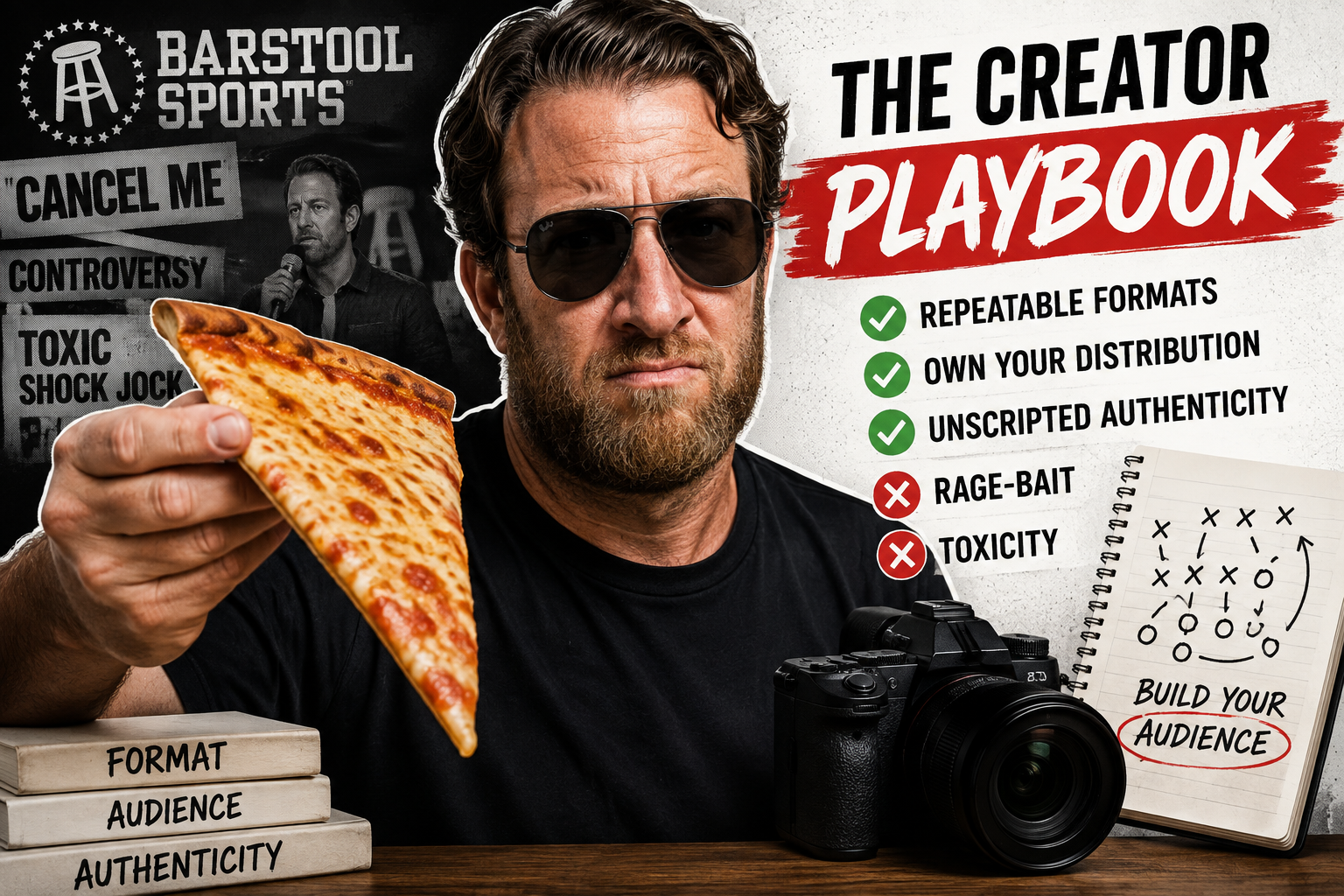
The Creator Playbook: What to Steal, What to Trash
Let’s break down what you can take from the Barstool machine without adopting the toxic baggage:
WHAT TO DO:
- Build repeatable formats. “One Bite” is a simple, infinitely scalable, and instantly recognizable format. Identify your niche’s core format and run it consistently.
- Own your distribution. Use email lists, your own site, or dedicated communities to reach your audience directly, so you’re not at the mercy of one algorithm or sponsor.
- Lean into unscripted authenticity. People don’t tune in to Portnoy for slick production or PR-polished scripts. They tune in because it feels real. So don’t edit out every trace of human personality from your work.
WHAT TO TRASH:
- Do NOT rely on rage-bait. Petty feuds create cheap, short-term attention, but they trap you in an endless cycle of being angry to stay relevant. It alienates great partners and burns out your real audience.
- Do NOT mistake toxicity for “being real.” It’s possible to be unfiltered, honest, and opinionated without being cruel or reactionary. Community is built by true authenticity, not by shock-value hostility.
The Bottom Line
You don’t have to endorse Dave Portnoy, and you probably shouldn’t. But you can still learn from his media empire. He proved a basic truth about the modern web: people don’t want sterile, corporate stuff. They want clear formats, real conviction, and direct communication.
Build your own repeatable format, own your distribution, and leave the chud behavior in the trash.