
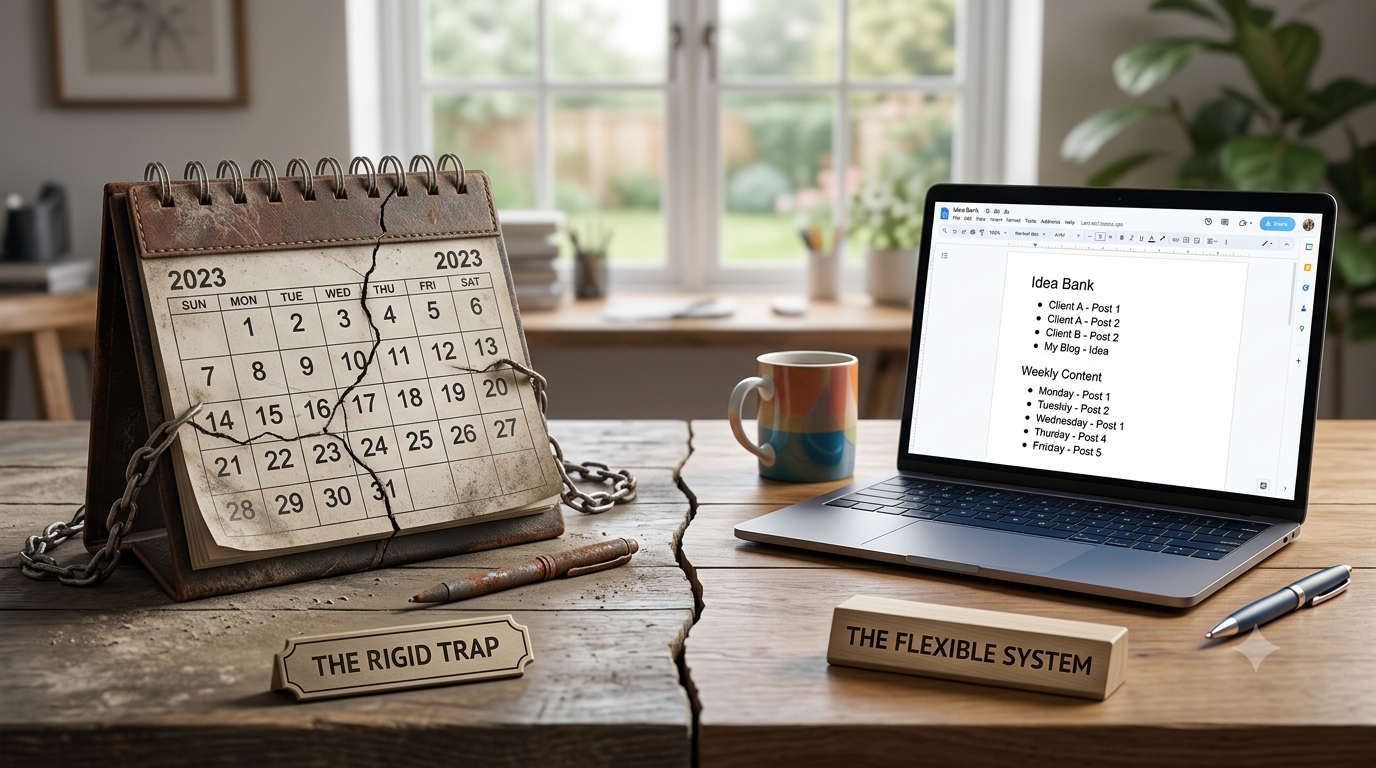
One of the hardest things about being a freelance content creator isn’t writing, designing, or pitching. It’s about managing your own time.
This becomes painfully true when you’re juggling multiple clients, keeping up with active projects, and trying to find a spare hour to work on your own business — you know, the administrative tasks, invoicing, and updating your blog.
But this becomes a problem as well. Since we’re all desperate for a magic bullet, productivity has become big business.
As a consequence, your feed is probably bombarded with “life-changing” advice from so-called productivity gurus every single day. They tell you to visualize your goals at 5:00 AM, time-block every hour of your day like a military operation, and theme your days so Monday is for “deep strategy,” and Tuesday is for “creative flow.”
However, if you want to get work done, the most practical, easiest tool is a content calendar.
Now, here’s where things get sticky. These same gurus and self-proclaimed experts love making this tool way more complicated and rigid than it ever needs to be. They want you to color-code your spreadsheets, set up complex automation triggers, and plan out your topics for the next year.
But as Hulk Hogan infamously said, “that doesn’t work for me, brother.’
The Big Lie of the Rigid Content Calendar
By treating your editorial strategy like a strict, unchanging publishing schedule, you’re setting yourself up for failure.
The biggest problem with rigid content calendars is that they sacrifice relevance for routine. Using set dates for your topics means you miss out on real-time trends, create forced content that lacks authenticity, and can’t adapt to changing news or algorithm shifts.
Specifically, if you treat your calendar like a sacred, unbending document, you’ll fall victim to four major pitfalls:
1. Missed engagement.
Algorithms are living, breathing things. In addition to rewarding real-time reactions, they also encourage commentary on current events. Posting weeks or months in advance can leave your content dated, out-of-touch, or completely tone deaf to what people are actually talking about.
2. Burnout and inflexibility.
Creativity doesn’t care about your calendar. Trying to write or brainstorm about a particular topic on a given date — especially when inspiration has dried up, or a client just threw you a curve ball — kills your creative drive and leads to procrastination.
3. Forced “filler” content.
It’s easy to create generic, low-value content when you’re forced to hit arbitrary daily or weekly publishing quotas. You’re no longer writing because you have something valuable to say; you’re just filling up screen space.
4. Neglecting the customer journey.
In static calendars, the what and the when take precedence over the why. Their focus is on “what to post” rather than the actual buying journey of your audience. The result? Rather than creating a cohesive sales funnel that converts readers into paying clients, you end up creating a bunch of noise.
How to Build a More Flexible Content System
I’m not suggesting you just wing it every morning. There’s no quicker way to panic attacks and missed deadlines than that. Instead, use a centralized Idea Bank with a flexible framework.
Will this work for everyone? Of course not. But here’s my method for creating a system that works in the messy, unpredictable world of freelancing.
Step 1: Create a centralized idea bank.
Don’t stare at a blank screen on the day you’re supposed to write. Keep a running list of brainstorms, frequently asked questions from your clients, or interesting industry news you stumble across during the week.
When it’s time to write, you pull an active topic from your bank instead of trying to come up with ideas. For me, this isn’t some high-tech project management software. It’s just a boring Google Doc. But, hey, it works.
Step 2: Stop planning for the entire year.
Don’t try to map out the next twelve months. You’re wasting your time. Instead, schedule your best ideas from your Idea Bank for the next three months.
By planning your content every quarter, you balance strategic focus with agility. In addition to being less overwhelming, a 90-day window allows you to align your messaging with seasonal trends and immediate business goals without having to commit to year-long plans that are outdated by February.
Step 3: Map your week in advance.
Take some time to plan your full week. Personally, I like to do this on Sunday afternoons, but you can do it whenever you have free time. It could be Thursday night as you relax or Saturday morning as you sip your coffee.
The point isn’t when you do it; it’s figuring out what you’re working on each day in advance.
My weekly business rhythm looks like this:
- Monday through Thursday. I plan to write and submit at least two articles for my main client.
- Fridays. I alternate my focus. One Friday is dedicated to Client B, the following Friday is for Client C, and the final Friday of the month is strictly reserved for whatever I personally need to do for me.
Step 4: Know when to batch your tasks.
I’m not opposed to batching. If done right, it’s incredibly effective, since you don’t have to switch between different client projects and tasks.
But again, keep it practical. Personally, I don’t submit an article to a client as soon as it’s finished. Instead, I’ll submit two or three at a time in batches. Why? Because the final delivery stage involves formatting, handling SEO metadata, and finding the right featured image. Compared to doing it three times, doing that administrative loop once for three articles is a huge time-saver.
Simplicity Over Hype
Yep. That’s it.
It’s incredibly simple, unimpressive, and definitely won’t win any awards on productivity forums. As freelancers, we can’t afford to waste time and energy on fluffy, overcomplicated productivity hacks. We need our time and energy to actually get our work done.
When a system requires more maintenance than the work it facilitates, it’s not a system; it’s a distraction. Be lean, be flexible, and leave the rigid calendars to the gurus.
As the great Walt Whitman once put it: “The art of art, the glory of expression and the sunshine of the light of letters, is simplicity.”