
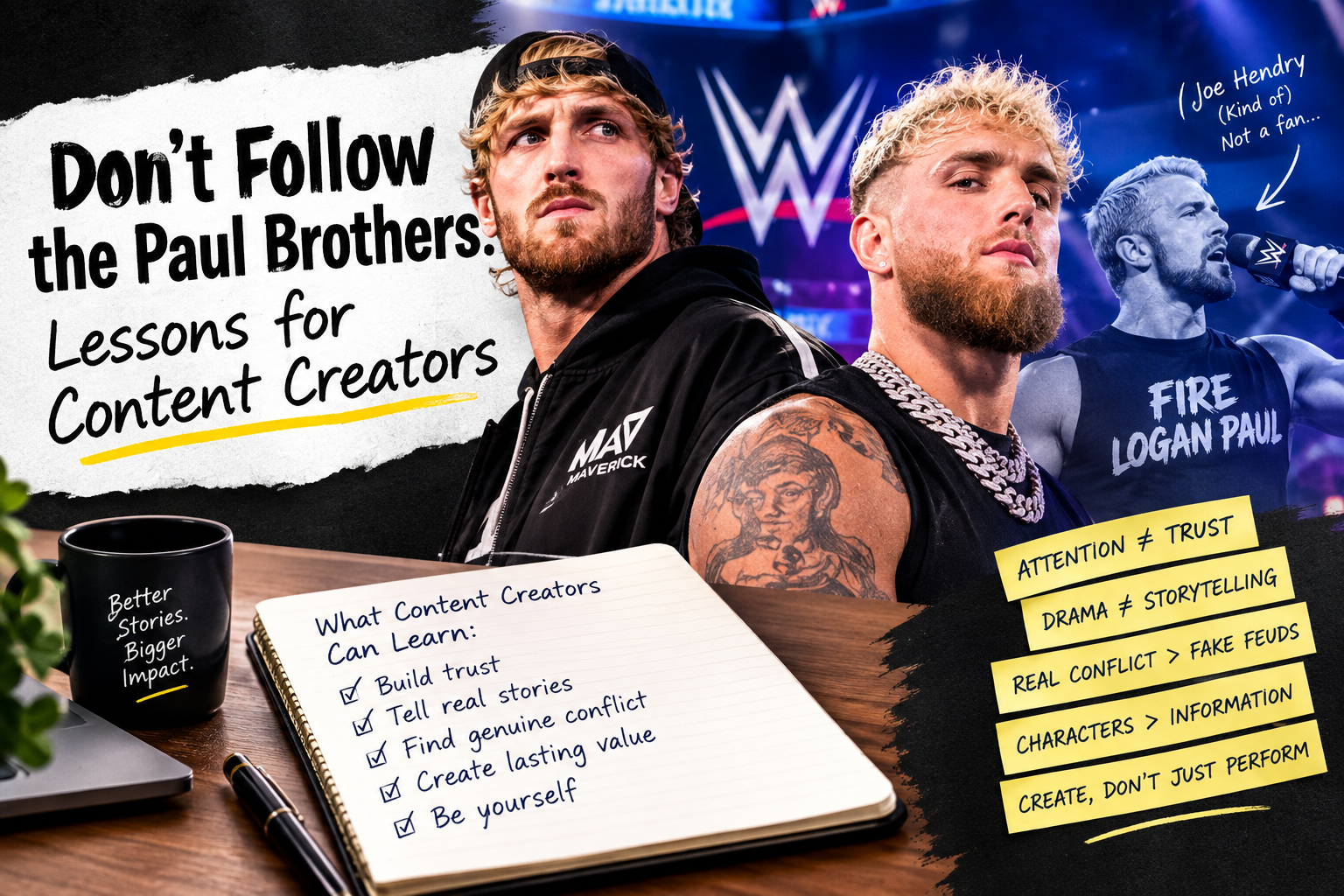
If Logan and Jake Paul can teach content creators anything, it’s how to get attention. Another thing they can learn is that getting attention and building a career worth having aren’t the same thing. That’s an important distinction in today’s creator economy.
I’ve spent years creating content, writing for different publications, researching unfamiliar subjects, interviewing people, and learning what makes people stop scrolling and read. And I’ve learned that there are two very different questions a content creator can ask: “How do I get people to look at me?” and “Why should people keep looking at me?”
In a way, the Paul brothers have turned the first question into a science. But I’m less interested in copying that playbook.
The Paul Brothers Built Their Brand on Attention
The Paul brothers didn’t begin their careers in boxing, pro wrestling, entrepreneurship, or business. They created content. After gaining fame on Vine, the brothers moved to YouTube, where their videos focused on pranks, stunts, humor, conflict, and their increasingly outrageous personalities. As their audiences grew, their careers in entertainment, sports, and business took off.
I’ll be honest. Their evolution has been impressive. It would be a mistake to dismiss their success, regardless of what you think about them. Unlike traditional media, they understood the internet’s advantage: attention. In addition, they understood that controversy attracts attention, and attention attracts opportunities.
Logan eventually entered boxing and then the WWE. As a WWE Superstar, he won the United States Championship and World Tag Team Championship. Jake chose a more conventional boxing path and built his business empire based on that. They didn’t just create audiences; they turned them into businesses. This could be worth studying. But it doesn’t mean you should copy them.
Lesson No. 1: Attention Isn’t the Same as Trust
My biggest takeaway from the Paul brothers would be this. In my experience as a writer, getting someone to click is only the beginning. Using outrageous headlines can create curiosity, controversy, or even make someone angry enough to engage with your article.
But what happens next? But does that person actually trust you? How often do they return? How likely is it that they would recommend your work to someone else? This is where the creator game really shines.
While the Paul brothers have built enormous audiences, their careers have also been plagued by controversy. In 2017, Logan, for example, faced widespread backlash after posting footage involving a deceased person in Aokigahara forest in Japan, as well as trying to inflate the market for Pokémon trading cards. Throughout his career, Jake has also faced numerous controversies, including allegations of sexual assault and calling the COVID-19 pandemic a hoax.
It’s not about re-litigating every controversy. The point is to recognize the trade-off: you can optimize for attention at the expense of trust. In the long run, trust is much more valuable than a viral post when you’ve built a personal brand over the years.
Lesson No. 2: Don’t Confuse Drama With Storytelling
Writers should pay special attention to this. Drama isn’t storytelling. Controversy isn’t storytelling. And being outrageous isn’t storytelling.
People are drawn to good stories because they’re able to relate to them. There is tension, stakes, character development, conflict, change, and a payoff. These things don’t need to be manufactured, because they’re everywhere. Whenever I’m writing, one of my favorite parts is discovering a story inside something that seems so ordinary on the surface.
Maybe a business owner isn’t simply “struggling with inflation.” She might be sitting at her kitchen table at 11 p.m. debating whether to hire the person she desperately needs. That’s a story.
A freelancer isn’t simply “burned out.” While staring at 51 unread emails, he realizes he’s built a business that requires him to be available 24/7. That’s a story.
A retiree isn’t simply “worried about running out of money.” It may be that she is 62 years old, has a seven-figure retirement account, and still can’t afford to spend $5,000 on vacation because she is scared the money will run out. That’s a story.
Ultimately, you don’t need a fake feud; you need curiosity.
Lesson No. 3: Don’t Manufacture Conflict When Real Conflict Already Exists
In the age of online creators, the Paul brothers became famous for proving that conflict travels. Yes, that is still true. A feud gets views, an argument gets clicks, and “creator destroys creator” is practically its own category of content.
When conflict is your entire creative strategy, you run the risk of losing focus. Eventually, you have to keep escalating. Pranks have to get bigger, feuds have to get nastier, and stunts have to get more outrageous. It’s exhausting to build a creative career that way.
There’s a better source of conflict: reality. Everyone has problems, every business has disagreements, every industry has competing interests, and everyone has something they’re struggling with. You don’t have to invent conflict; you just need to find it.
Lesson No. 4: Learn From Logan’s WWE Career—But Remember It’s Entertainment
This is where things get particularly interesting. Logan Paul has actually established himself as a legitimate force in WWE. In 2022, he signed a WWE contract after making his in-ring debut at WrestleMania 38. As a result, WWE has positioned him as a major performer, and he has won both the United States Championship and the World Tag Team Championship.
Yes, as a wrestling fan, that ticks me off. However, content creators can learn a lot from that. Wrestling is fundamentally about character, anticipation, and making audiences emotionally invested in what happens next. To put it another way, WWE understands something every content creator needs to know: people follow characters instead of information. And Logan has become very proficient at playing one.
In fact, fellow WWE performer Joe Hendry has leaned into that dynamic with the song “Fire Logan Paul.” WWE released the song and video as part of the storyline, with Hendry portraying himself as someone who wants Logan gone from the company. And yes, I know that’s kayfabe – but that’s the point.
Audiences don’t need to believe that the performers genuinely hate one another to enjoy the program; they simply need to feel that the story is worth watching. That’s a lesson worth stealing. Not the fake feud, but the storytelling.
Lesson No. 5: Your Audience Is Smarter Than You Think
Often, creators assume that they must shock their audiences constantly. They don’t. It’s not like readers and viewers are stupid. People can sense when something feels manufactured, when you’re following a trend, or when you’ve transformed your personality into a performance that doesn’t reflect who you are.
As a writer, I’ve encountered this repeatedly. It’s not necessarily the pieces where I’m trying the hardest to sound clever that work best; it’s the ones where I’m trying to help.
Clear always beats clever. Specific is better than sensational. Honesty tops manufactured. And a genuinely interesting idea outshines another recycled piece of outrage.
Lesson No. 6: Don’t Build a Brand You Have to Constantly Perform
In my opinion, this is the biggest reason why I would not recommend following the Paul brothers’ model. Their careers are built around their larger-than-life personalities. That’s their product.
That’s a terrible business model for most content creators. When your brand demands that you constantly be outrageous, controversial, louder, or more entertaining than you were yesterday, you’re eventually going to run out of runway.
I would rather build a brand around things I am passionate about: expertise, curiosity, point of view, sense of humor, and a knack for asking the right questions. Things like that compound.
The Real Lesson From the Paul Brothers
In an ironic twist, I say not to follow the Paul Brothers, while at the same time saying there is much to learn from them. That’s intentional.
They’ve demonstrated some remarkable principles. They know how to leverage one platform into another, and how controversy can create momentum. However, creators need to distinguish between what works and what’s worth copying. The longer I write, the more conscious I am of that distinction.
You don’t have to adopt someone’s entire philosophy to learn from their success. You can study a viral headline without becoming a rage bait writer. You can study an influencer without becoming an influencer. And you can learn how someone captures attention without deciding that attention is the only metric that matters.
It’s more valuable to be remembered for the right reasons than to go viral. That’s the kind of content career I want.
Don’t follow the Paul brothers. Study them. Understand how they became successful, why controversy works, and how they turned attention into business. After that, take what works, leave what doesn’t, and build something you’re proud of.
Because in the long run, the goal isn’t simply to get people to watch – it’s to give them a reason to come back.