
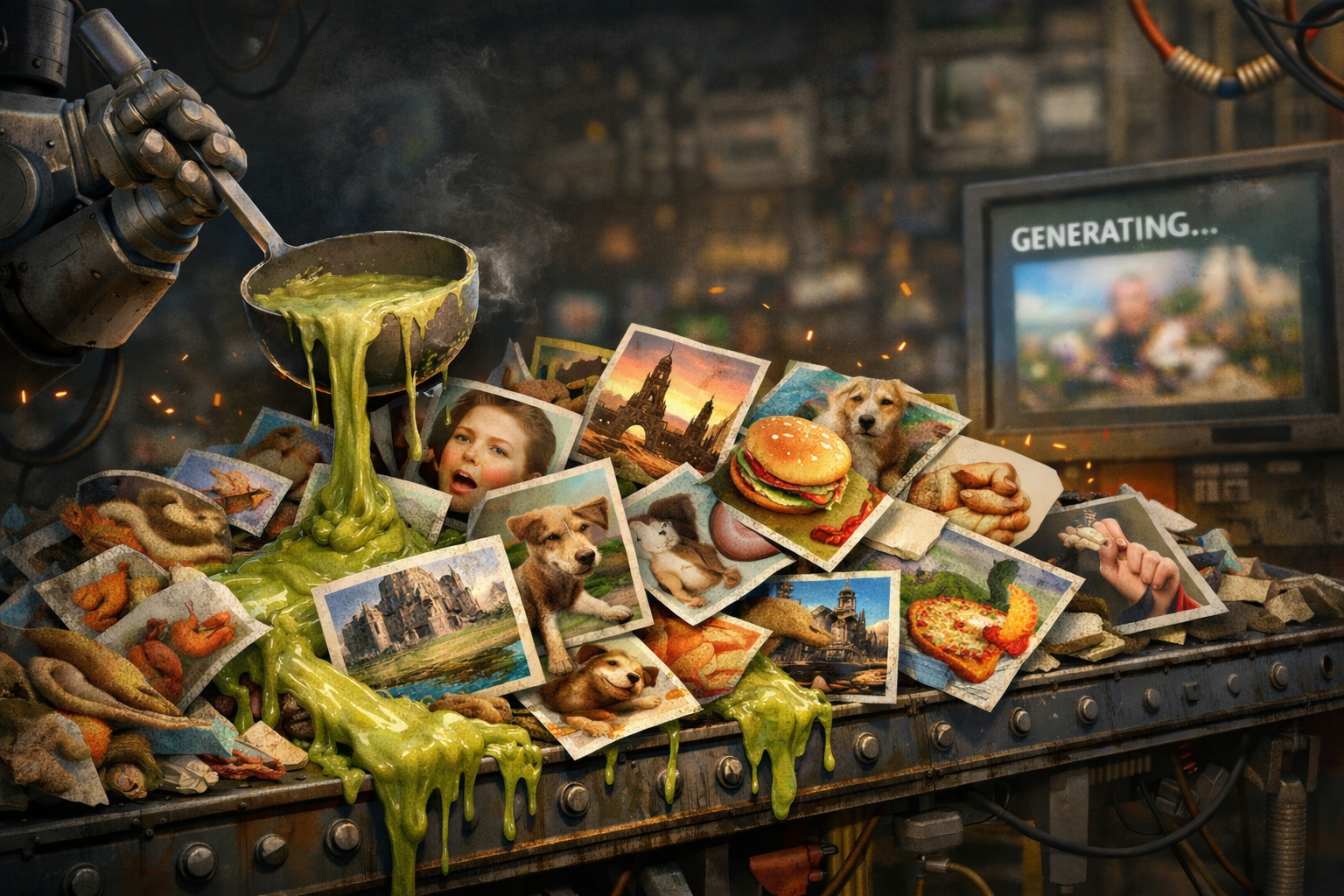
It’s obvious to anyone who spends more than five minutes on social media nowadays that things have changed. We’ve all seen those hyper-shiny, weirdly perfect images on Facebook, hollow “inspirational” posts on LinkedIn, and TikTok videos with annoying robotic voices. And, has anyone escaped their Instagram feed without seeing an AI-generated video of a rooftop infinity pool’s glass edge shattering?
Even worse? Increasingly, low-quality, AI-generated content is used in political discourse, campaigns, and propaganda to create misleading images, audio, and videos, which muddy the information environment and make truth more difficult to discern.
We’ve entered an era of “infinite scroll, zero substance.” For those unfamiliar, this phrase describes modern social media’s addictive and unfulfilling nature. Basically, it’s all about endless scrolling, which offers a never-ending stream of content without natural stopping points, resulting in excessive, passive consumption of low-value info.
More specifically, we call this AI slop. As with high-fructose corn syrup, it’s mass-produced, has zero nutritional value, and is designed solely to keep you clicking so ads can be displayed.
As AI slop won’t disappear entirely, we need to become better at separating what’s real from what’s just machine-generated noise.
What Exactly is AI Slop?
AI slop isn’t just content made with AI; it’s content produced entirely by AI. Specifically, it consists of low-quality, mass-produced, generic digital content generated entirely by AI without human interaction, often lacking originality, accuracy, and deeper meaning, in contrast to thoughtful collaborations between humans and AI.
Even the worst blog posts took a human to actually write in the “old days” of about three years ago. In other words, it took effort to be mediocre. AI slop eliminates the effort. This is what happens when someone types “write a post about success” into a bot and then pastes the result without checking. Basically, it’s “unmanaged” noise based on the average of everything else on the internet.
The Forensic Eye: How to Spot the Fake
You don’t have to be a computer scientist to spot AI. It only takes a “BS detector” to detect the Uncanny Valley — you know, that feeling of being uneasy when something looks like a human but feels strange to you.
Look for the paper trail.
- Check for watermarks. AI tools (like OpenAI’s Sora) hide a tiny logo in the bottom corner. If you don’t see a logo, look for “spongy blocks,” which are blurred or smudged patches where a watermark was scrubbed away.
- Check the “file info.” Each photo and video contains “metadata” — a digital fingerprint. According to CNET, it’s easier than you think to check. In many AI videos, you’ll see “content credentials” that admit that the video was made by a computer.
Check the logic.
- Listen to the voice. As a result of our emotions, we slow down or speed up according to our rhythm. AI voices are often unnaturally rushed or flat.
- The reality check. Ask yourself, “Is this even possible?” As Princeton professor Zhuang Liu says, if you see a horse on the moon or a chair made of avocado, it’s obviously AI.
- Word salad. There’s nothing AI loves more than fancy, profound-sounding sentences that, if read twice, have no real meaning.
Trust your gut.
- Check the source. Be suspicious if you see a “breaking news” video posted on a meme page rather than a reputable news source.
- The bottom line. When something feels unreal, it probably is. By default, don’t believe everything you see.
The “Lived Experience” Filter
There is no better weapon against slop than the “I” factor. Although AI is based on math, it has never felt the pain of failure or grief. Also, it hasn’t experienced the dopamine rush of success.
To put that in perspective, here’s an example.
- Slop says. “Consistency is essential for growth.” (Generic)
- A human says. “I tried posting every day for a month and it nearly destroyed my marriage. Here’s what I’d like to do instead.” (Real)
In short, human-only assets are often your best defense: your mistakes, your weird hobbies, and your “unsanitized” opinions that a bot couldn’t pass on.
Algorithmic Hygiene: Stop Feeding the Beast
Whenever you comment on AI slop, even if you’re just making fun of it, the algorithm sees “engagement.” It rewards the bot like a puppy getting a treat for learning a trick.
- “Block and starve” strategy. If an account posts low-effort AI junk, don’t just scroll past it. You should block it. Think of it like pruning your digital garden.
- Support “friction”. Engage with content that took time and effort to create. Long essays, raw podcasts, and behind-the-scenes videos are examples. Usually, if something looks like it took a long time to make, it is worth your time to spend on it.
Proof of Human: Our New Responsibility
Whenever you use AI to assist you with your work, it’s still your responsibility to prove you’re human. You can think of it as your “Watermark of Intent.”
When using AI to outline ideas, you must fill them in with your own words and stories. Now that we’re in the new era, taking your work seriously means being transparent about where you end and the machine starts. If you’re just copying and pasting, you’re not a creator — you’re a copycat.
The Danger of the “Feedback Loop”
The real tragedy of AI slop is the “digital inbreeding.” This occurs when AI models learn from content created by AI. Eventually, the information becomes distorted, bland, and inaccurate.
Whenever we consume slop, we are part of the loop. When we are fed opinions that have been “averaged out,” we lose the ability to think for ourselves. Breaking the loop means looking for “weird” stuff, deep stories a machine wouldn’t consider.
Conclusion: The Value of the Hand-Crafted
There’s no denying that we live in the “fast fashion” era of content: it’s cheap, it’s everywhere, and it’s crumbling. But just as people still value a home-cooked meal, like my mom’s baked gnocchi, handcrafted ideas will always be valued.
Attention is the most valuable possession you have. Don’t waste it on digital junk mail. Find the flaws. Find the soul. And, above all else, stop falling for the slop and start demanding the signal.