
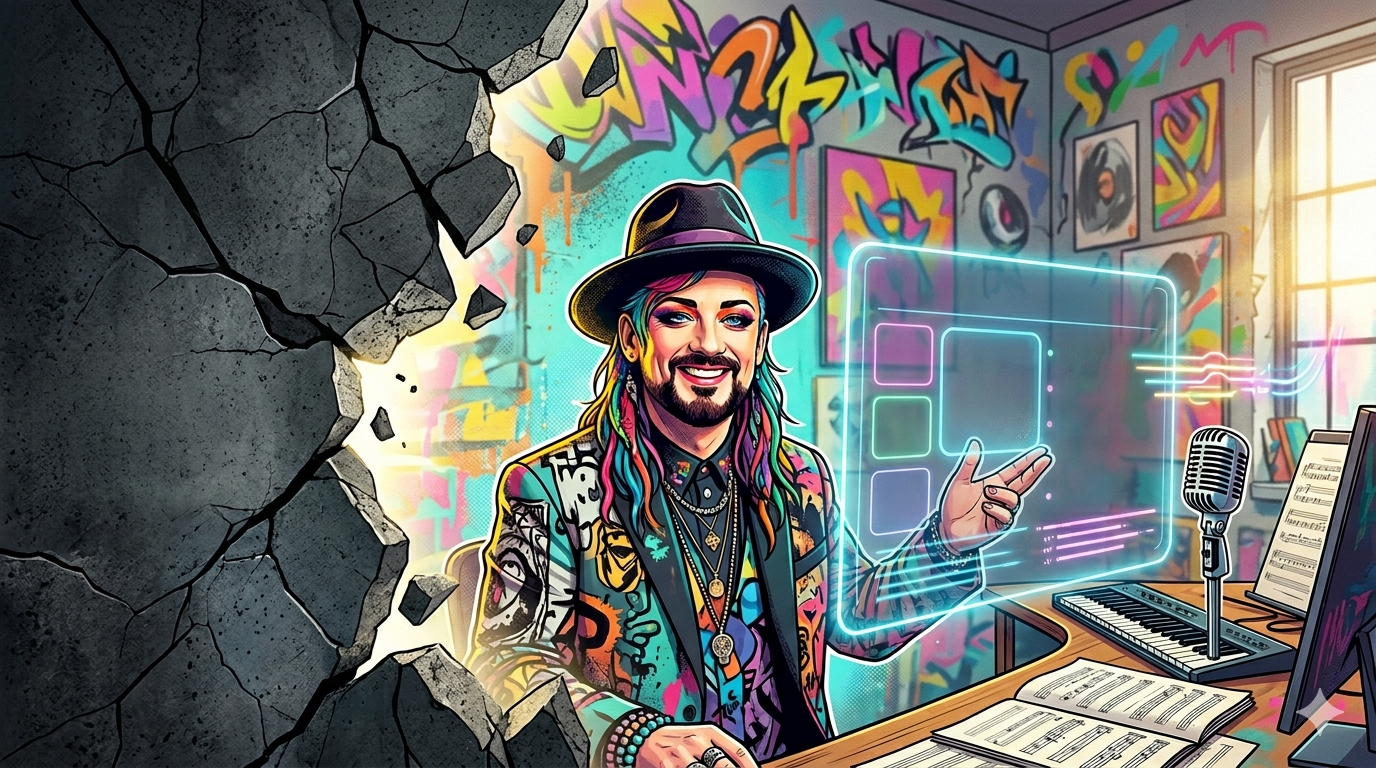
Almost every day, I hear someone in the creative community critique AI with skepticism and existential dread. I’m sure you’ve also seen headlines like “Is AI Killing the Writer?” or “The End of Human Art,” or have discussed this with others. But while many are freaking out and losing their collective minds, a legendary icon shows us how to build a stage.
Boy George, you know the voice of “Karma Chameleon” and a man who has reinvented himself more times than most brands have updated their logos. He recently dropped a bombshell and said the loud part out loud. Using AI tools like ChatGPT, he’s written about five albums.
Instead of just using it, he’s embracing it as his main collaborator. For content creators, digital entrepreneurs, and writers, George’s proactive stance isn’t just a quirky celebrity story. It’s an excellent lesson in modern creative survival.
1. Training the Muse: AI as a Songwriting Partner
Boy George doesn’t treat AI like a vending machine where you put in a prompt, and you get a finished song. It’s like a bandmate to him. He says that “you can train it,” which underscores an important point: AI is a tool for refinement, not just creation.
Often, we fall into the trap of thinking AI will do all the work for us or should be avoided like the latest Kid Rock single. George’s approach offers a middle ground. Basically, you provide the soul, AI provides the structural variation, and you polish it up.
The lesson? Don’t just accept the first draft ChatGPT gives you. Instead, use it to generate 50 headlines or song titles, then use your intuition to pick the one that “vibes” and refine it.
2. The “Effort” Litmus Test
George’s blunt assessment of the labor market deserves a chef’s kiss: “If you get replaced by a robot, you weren’t trying hard enough.”
My cousin, a creative technologist who you should check out over at Fresh Cake, and I said the same thing in February when I visited in New Hampshire. This is a jolt of reality for anyone in the content industry. If your work is so formulaic, so soulless, and so clone-like that a Big Language Model can replicate it perfectly, the problem isn’t the tech; it’s you.
AI allows George to concentrate on the artistry of the music instead of the “heavy lifting” of brainstorming and structure. Even a guy who’s been writing hits for forty years admits ChatGPT has “really helped me as a lyricist.” As content creators, it’s also about fine-tuning our content.
- The structural “editor.” There are times when you have the right ideas, but the flow is wrong. AI’s awesome at looking at long drafts and suggesting a more logical sequence. It’s like having your own editor on call 24/7.
- The nuance check. By asking AI to “check for tone” or “simplify this complex financial jargon,” you ensure that your message is reaching your target audience.
- The technical safety net. Grammarly helped pave the way for this. I’ve been using AI for years to fix my grammar and enhance my vocab. As generative AI advances, it makes sense to move beyond simply fixing commas to improving clarity.
Rather than hitting “generate” lazily, George is “trying harder” and exploring musical styles he might not have otherwise down before.
3. Resurrecting the “Unfinished”
All of us have a digital “junk drawer.” You know what I’m talking about. You know, that Google Doc full of half-finished blog posts, newsletters that never launched, and ideas that almost took off but never did.
With AI, George has brought old, unreleased concepts to life. This is the ultimate productivity hack for creators. Using AI, you can connect disparate ideas. You can feed it an old outline from 2022 and ask it to view it through the lens of trends from 2026. In other words, you can breathe new life into the graveyard of your creative archives.
4. The Proactive Pivot: Monetization and Production
Rather than just experimenting with AI, Boy George intends to monetize it. From ideation to production to profit, he examines the entire creator economy lifecycle.
That’s kinda a big deal. Most creators are stuck in the endless “wait and see” phase. They may be waiting for copyright laws to settle. Others might wait until “the hype” subsides. Meanwhile, the most successful creators are already incorporating these tools to increase their productivity and reach.
| The Old Mindset | The Creator Mindset |
| “AI is cheating.” | “AI is an instrument.” |
| “I’m worried about my job.” | “I’m expanding my capacity.” |
| “AI content has no soul.” | “I am the soul; AI is the engine.” |
5. Cultivating Your “Sonic Signature”
Boy George’s music still sounds like Boy George, even when AI is used. In other words, this is the “Sonic Signature” – the unique thumbprint left by a creator.
Digital marketing and SEO often revolve around E-E-A-T (Experience, Expertise, Authoritativeness, and Trustworthiness). In order to gain expertise, AI gathers data, but it’s up to you to provide the experience.
By using AI, George shows that technology should not muffle, but amplify your voice. It doesn’t matter if you’re writing about tax-advantaged retirement accounts or the best baseball movies of all time, AI can help you organize the facts, but what keeps the audience coming back is your “voice” – your quirks, your stories about being the cool uncle, your unique worldview.
Embracing the “New Romantic” Era of Content
We’re not just entering a new era of digital creation; we’re in the thick of it. We live in an era when the entry barrier is lower than ever, but the bar for “greatness” is higher.
Boy George has transitioned from vinyl to cassette to CD to streaming, and now he’s transitioning from human-only to human-AI hybrid. He’s not surviving by sticking to “the way things used to be.” He’s surviving by being the most proactive person around.
If you’re a creator, the message is clear: Don’t be afraid of the machine. Train it. Collaborate with it. Most importantly, outwork it with your own humanity.
So the next time you get stuck, don’t see AI as a threat. Think of it as your new songwriting partner. What’s good enough for a Grammy winner should be good enough for your next blog post.